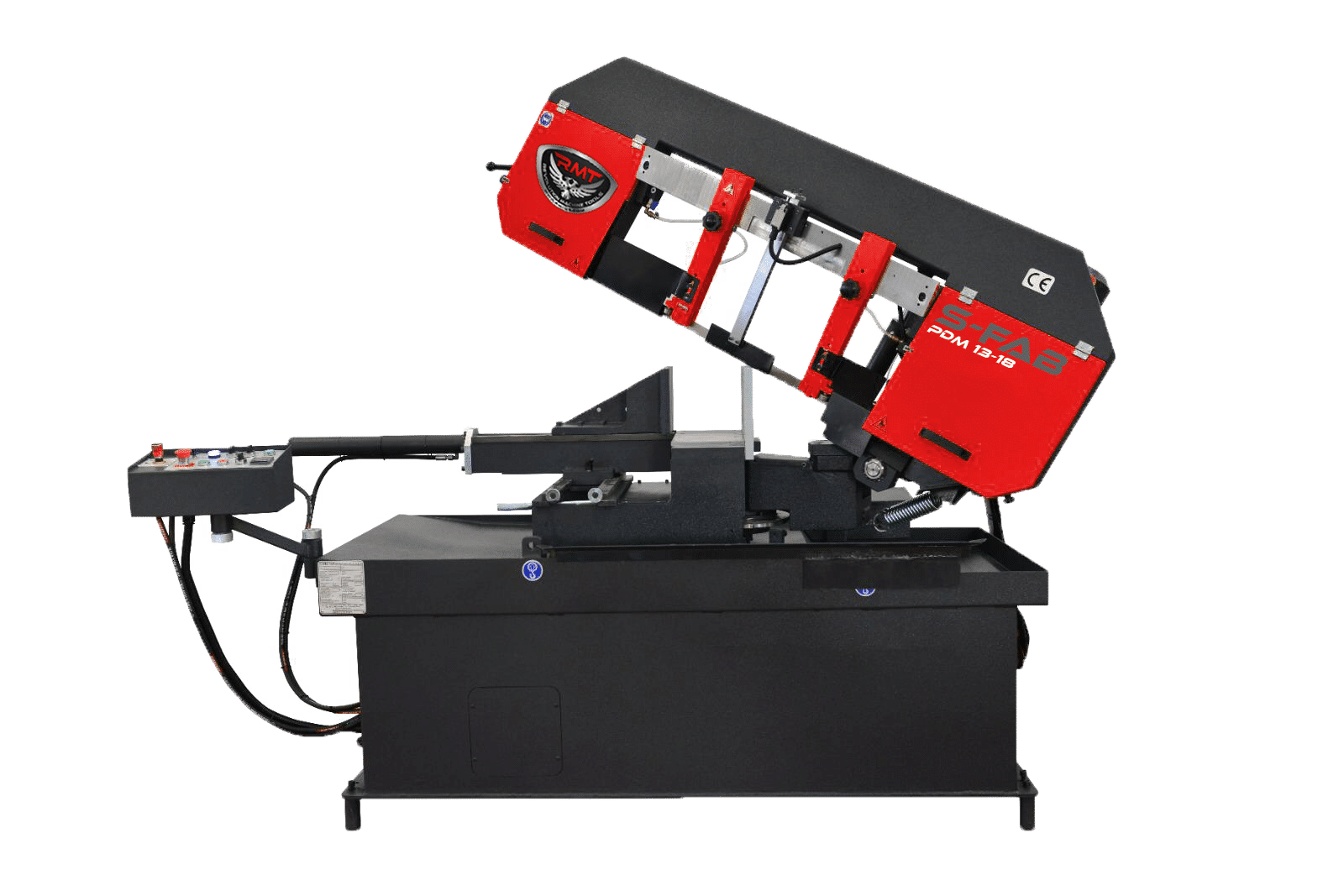
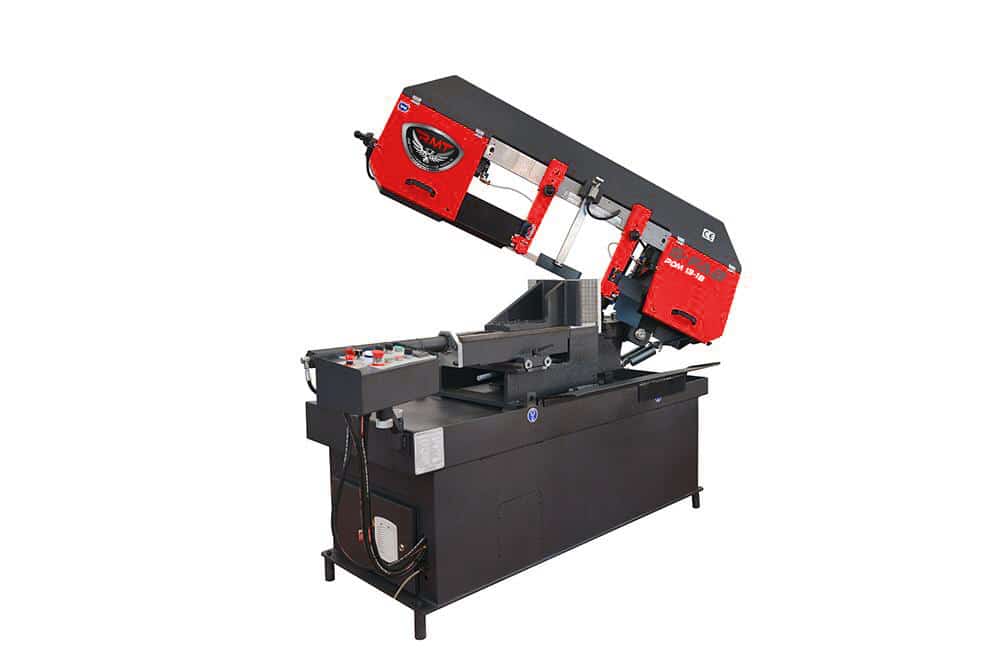
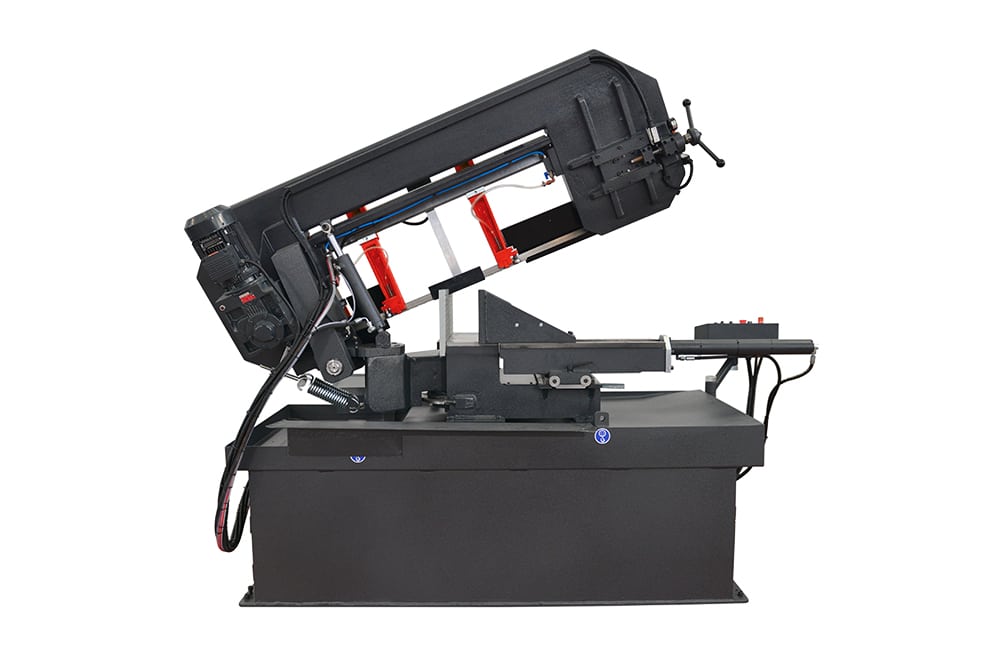
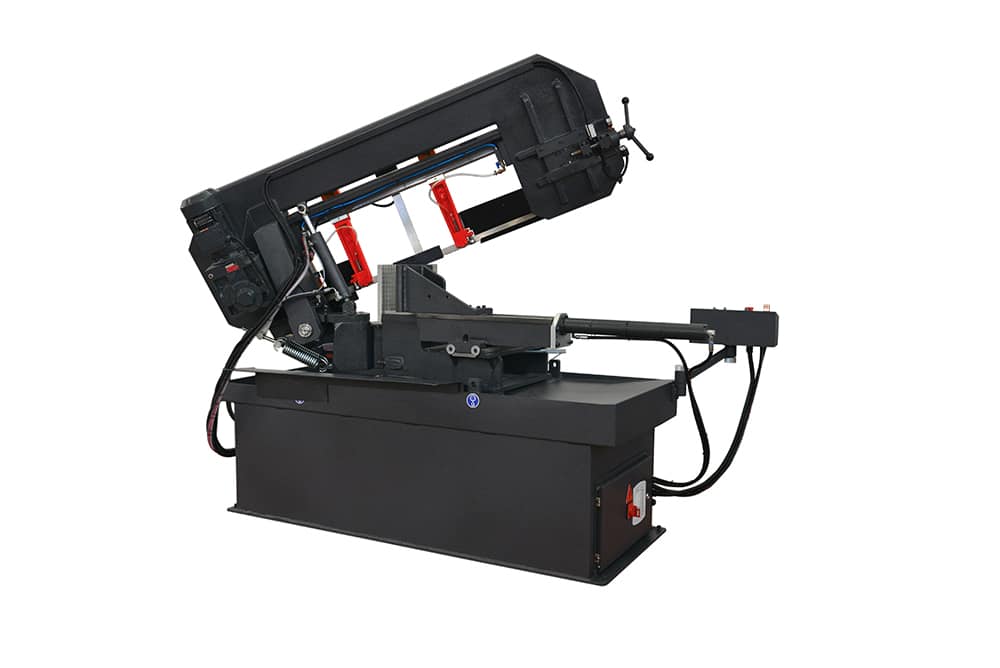
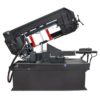
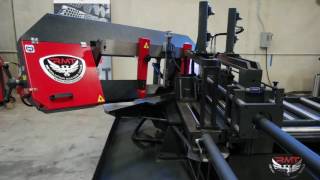
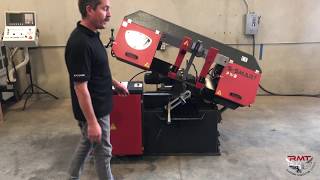
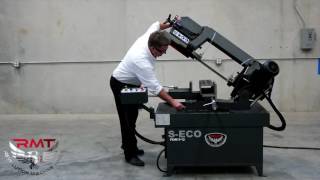
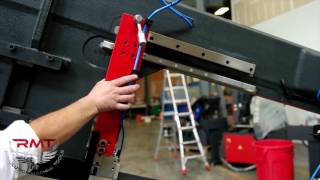
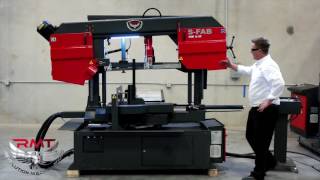
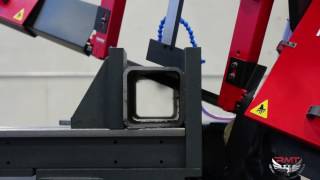
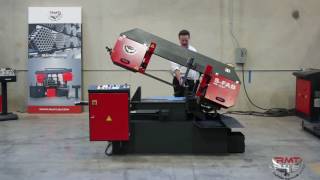
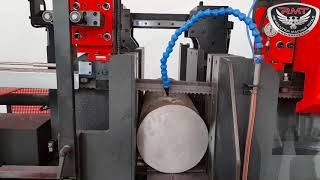
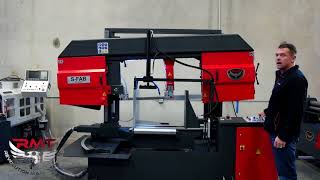
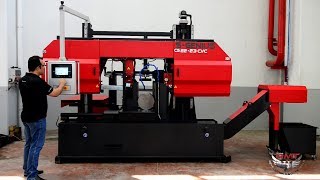
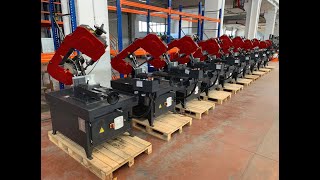
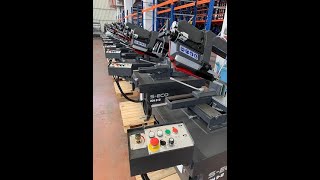
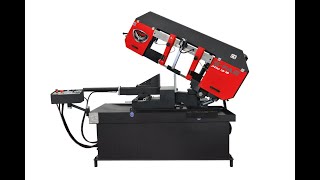
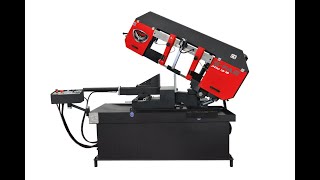
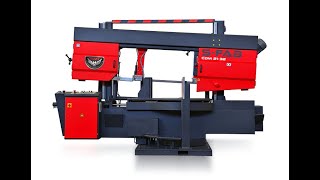
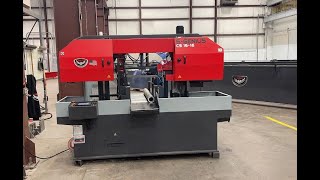
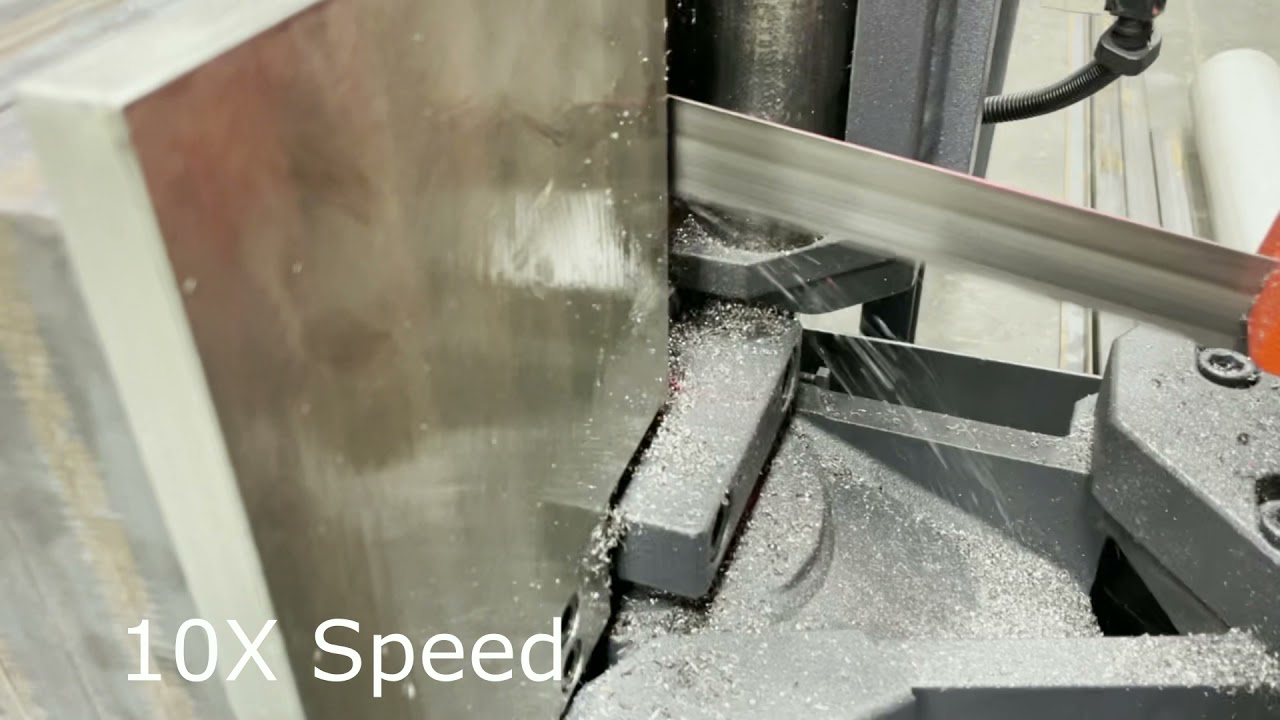
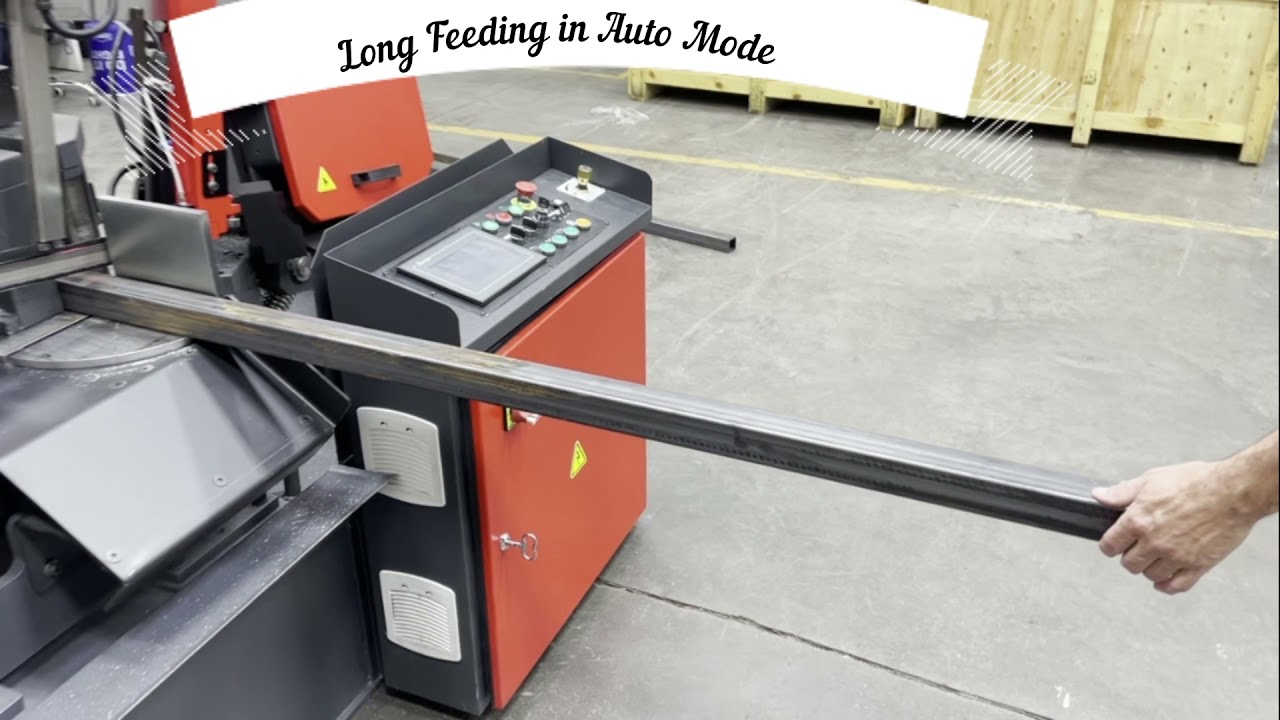
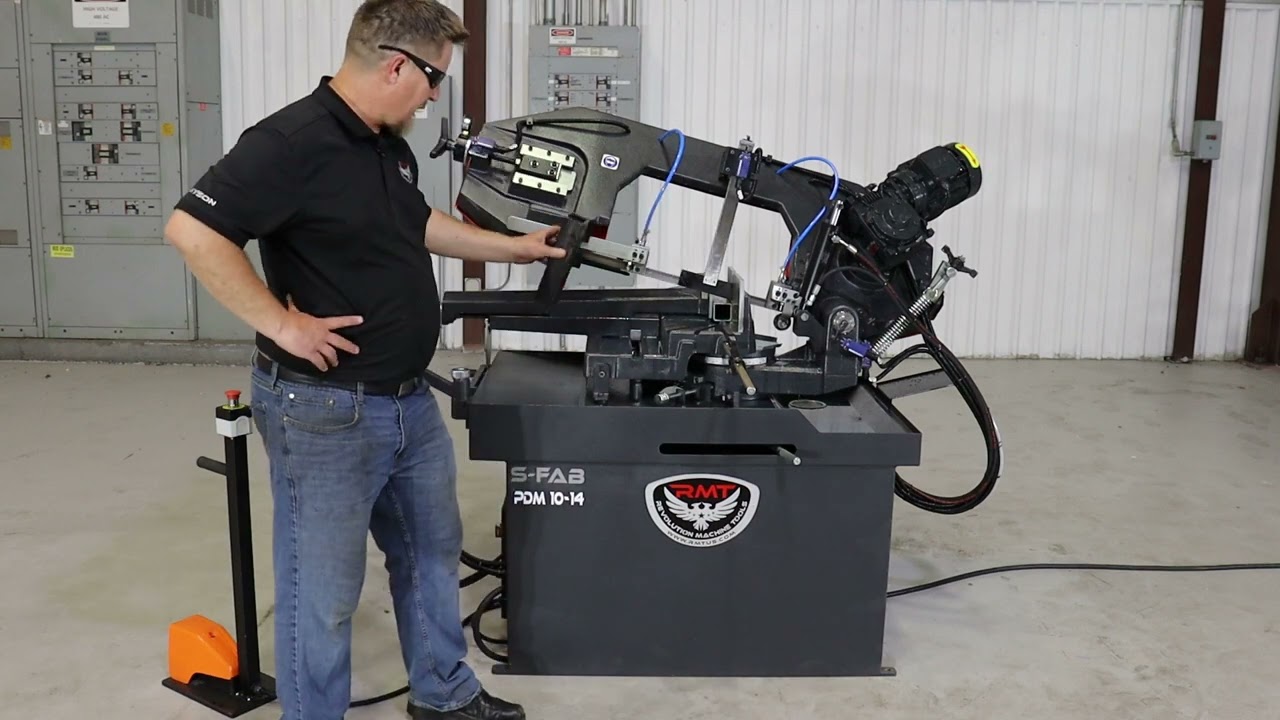
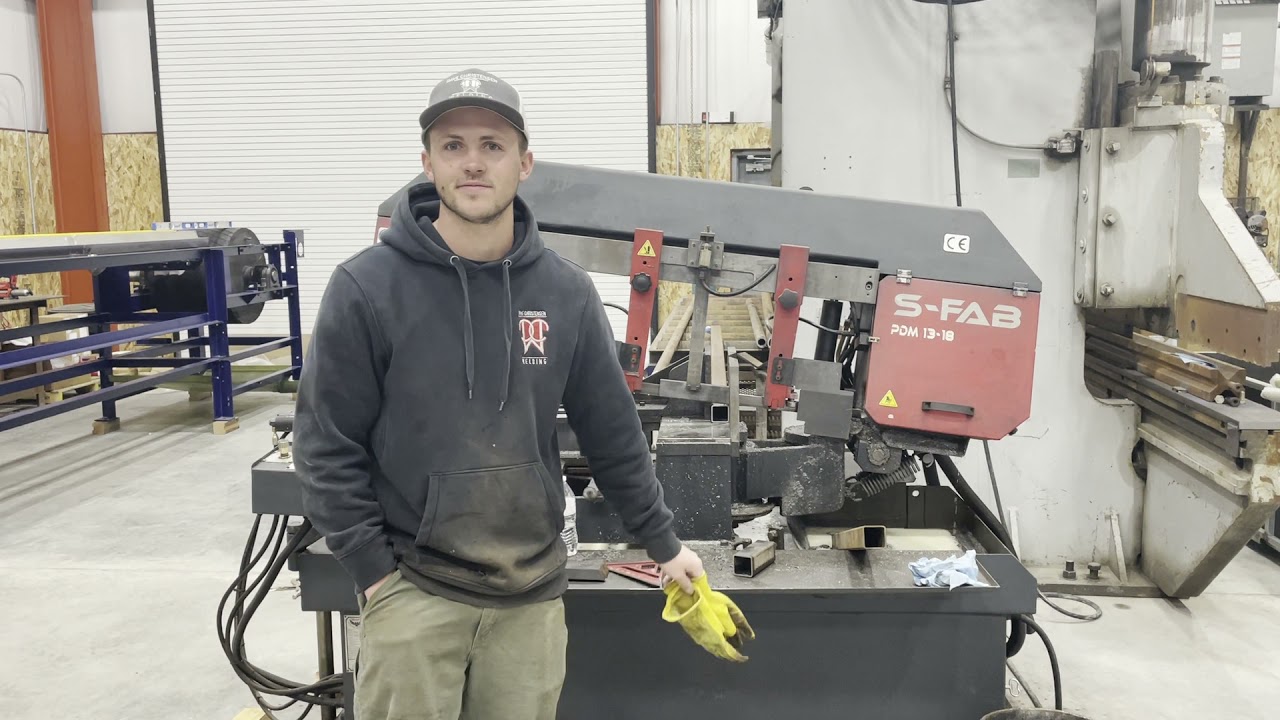
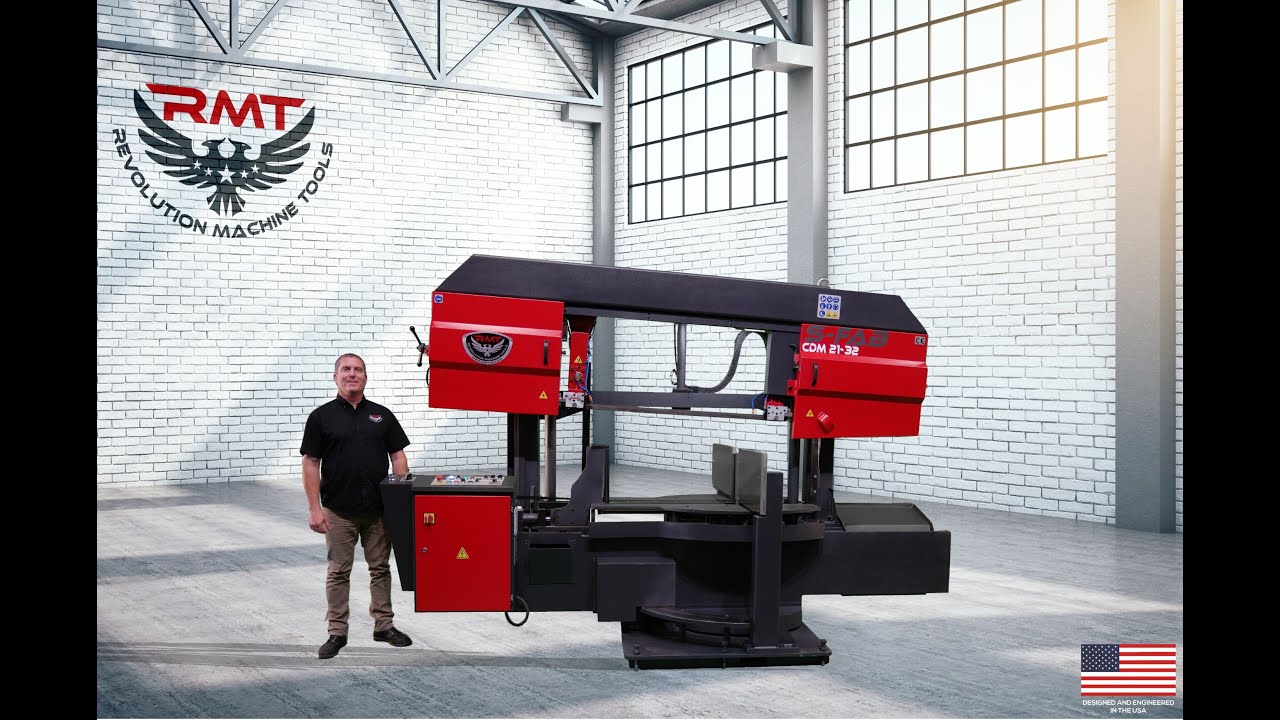
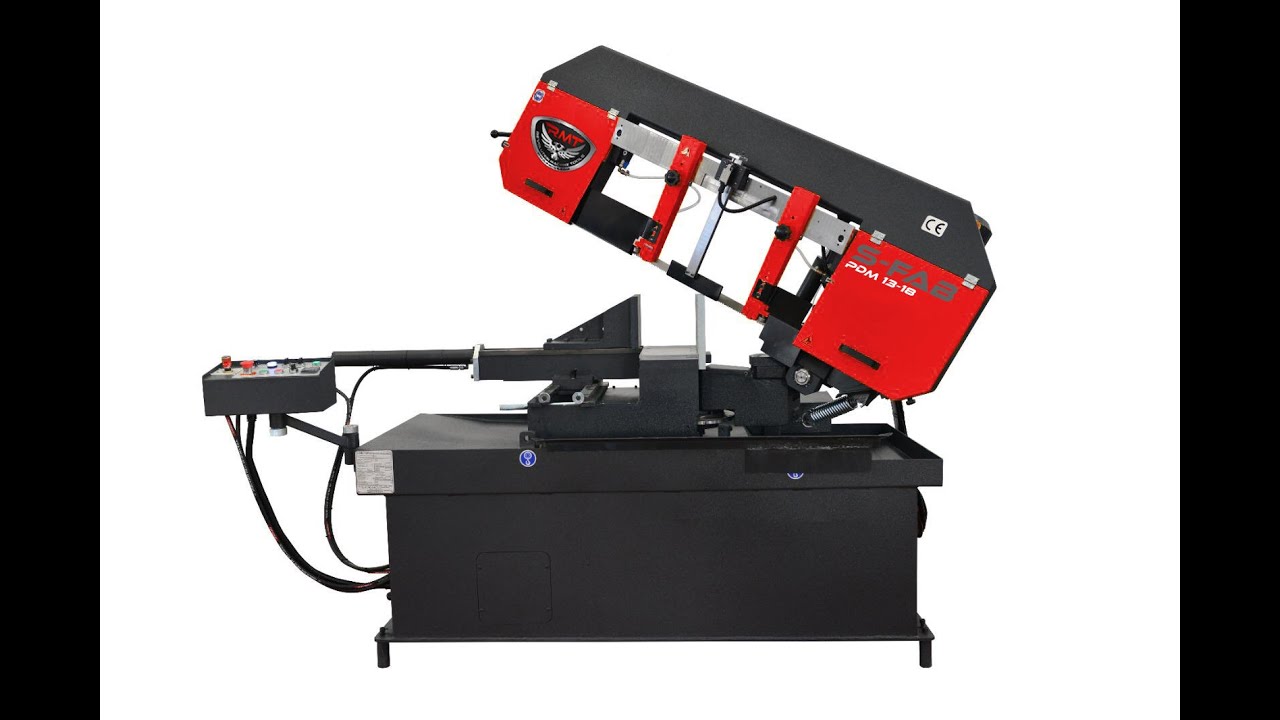
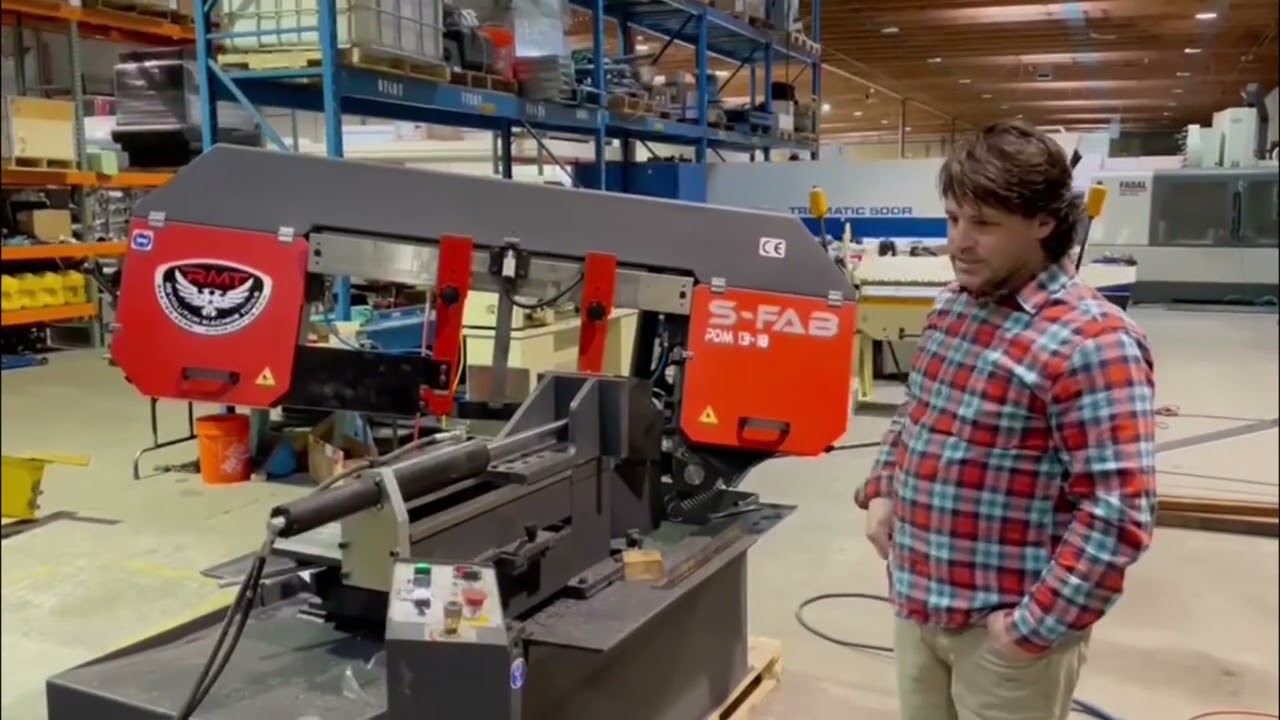
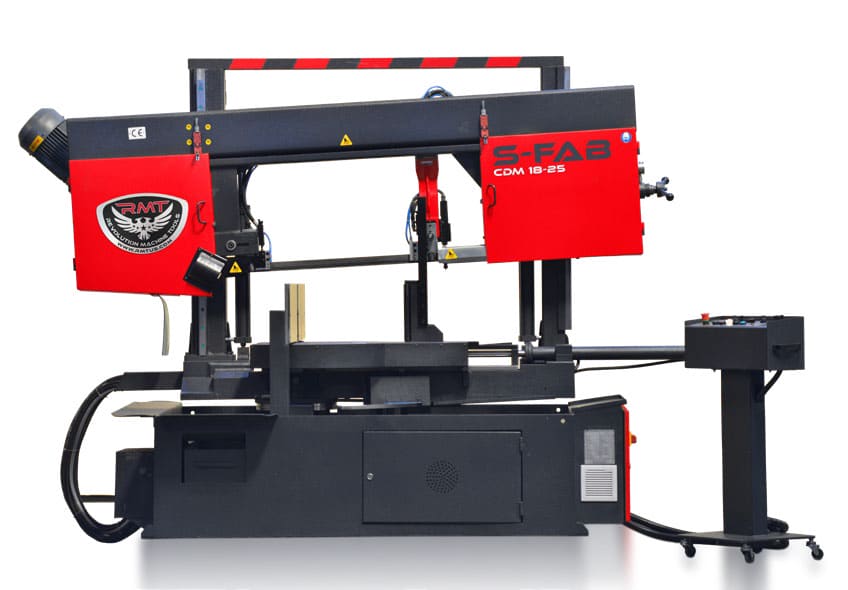
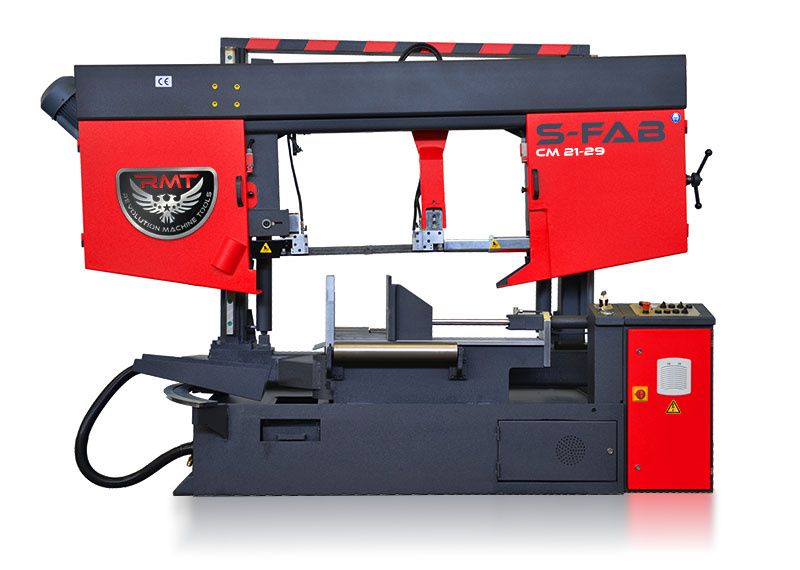
The Revolution Machine Tools™ S-FAB™ PDM 13-18 Semi-Automatic Pivot Type Double Miter Bandsaws are ideal for angled material cutting with variable number of cuts. The cutting capacity of this machine is 13” x 18” in 90° flat cuttings and Ø13” in round material. It is possible to make angled cuts between +45° RIGHT -60° LEFT degrees. Our machines make the cutting hydraulically and automatically rise to the cutting height after the cutting is finished. The material is manually driven up to the stop and the cut is repeated.
The S-FAB™ PDM 13-18 comes standard equipped with a control panel, blade brush, hydraulic vise, material length stop, security switch, height adjustment switch, Siti heavy duty gearbox, infinite variable speed inverter, sensitive pressure control, hydromechanical blade tension, optical saw height adjustment, anti-vibration cylinder, coolant pump, digital angle readout, 230V or 440V 3 phase power.
Buyers have the option to add any of these additional features to their S-FAB™ PDM 13-18 Bandsaw as well: Hydraulic blade tension, DropsA air/oil clean lubrication system, micromist cooling, 10ft roller table with the option to make the table motorized, laser line, and single phase – 220V 1 phase power.
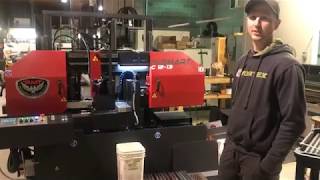
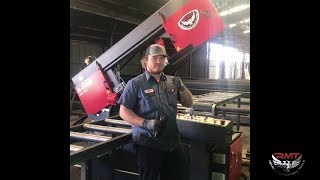
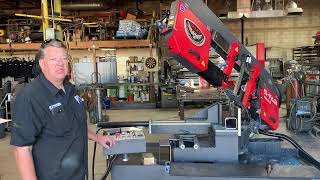
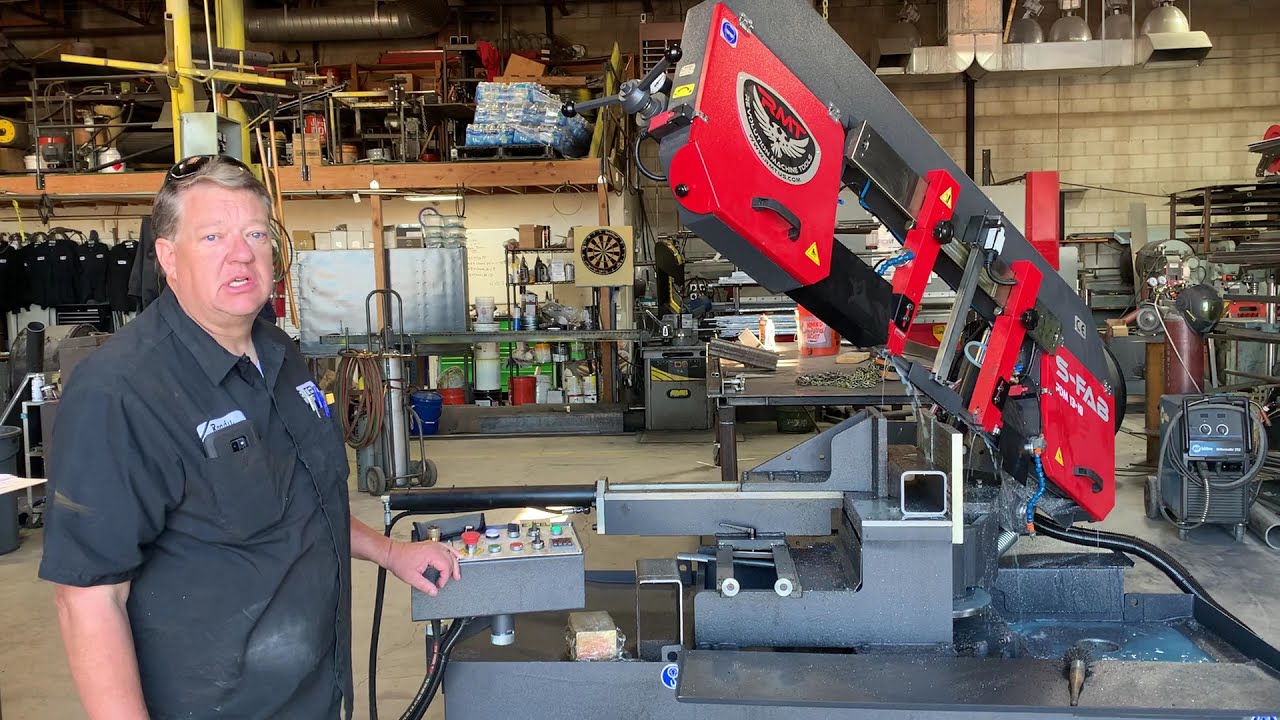
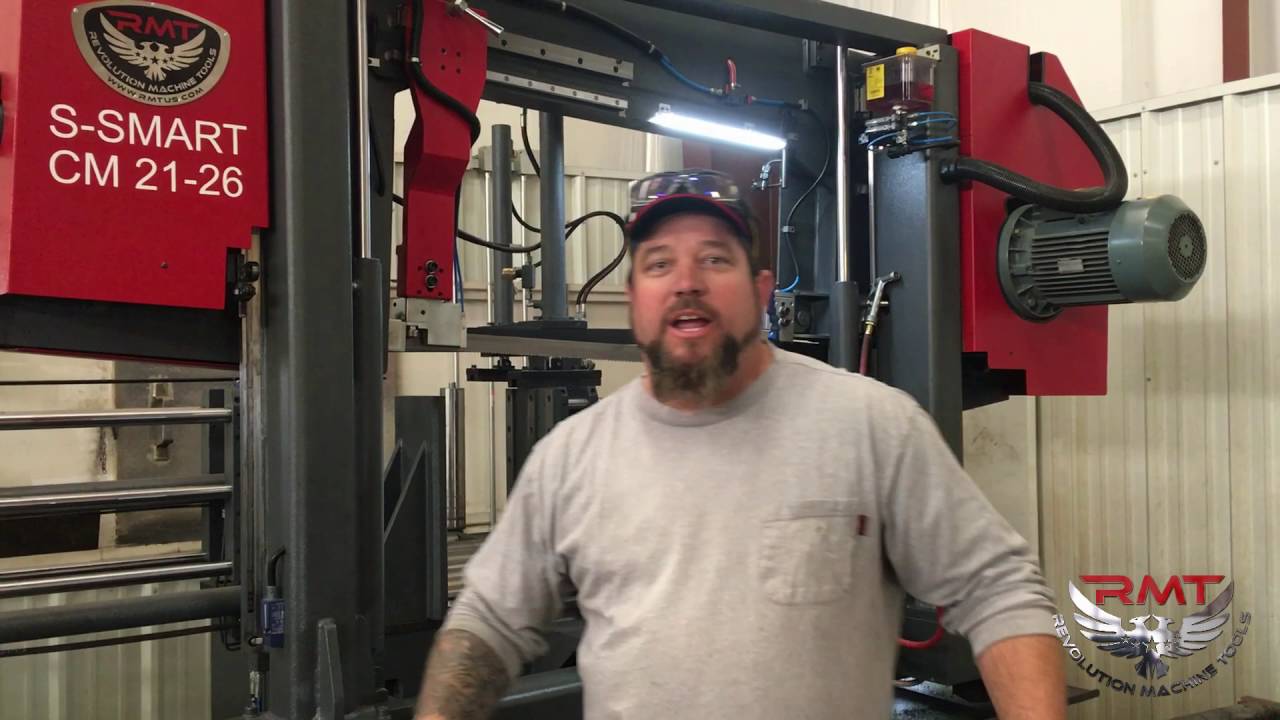
Pro Fab and Welding of Pleasant Grove, UT became the latest recipient of one of our new metal cutting band saw models. Fully automatic and loaded with features this saw makes short work of large bundles, even allowing up to a 60-degree miter. Joe, the operator for Pro Fab and Welding has been working with saws for 25 years and told us that, "This saw kicks butt" and "runs better than any saw I've ever had." He also made several comments about really wishing he had a couple of them, to which we just smiled.
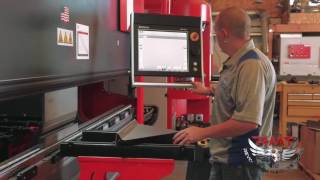
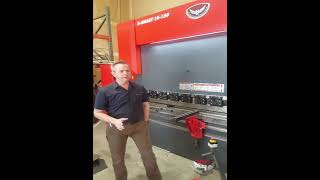
Testimonial for the B-GENIUS Revolution Machine Tools Press Brake Finn Kool - Kansas
We take pride in every machine we sell. It makes us extremely happy when our customers do also 🙂
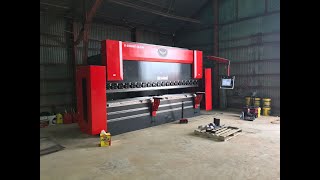
These Press Brakes feature a servo driven back-gauge system for faster speeds and better accuracy. The automatic CNC crowning system improves part quality. A 3D-capable Graphical Control Unit simulates bending sequences and detects collision points before you begin the bend. B-GENIUS Press Brakes have exceptionally large strokes, huge daylight, and throat depths to accommodate deep bending and long tooling.
Another satisfied customer! We just delivered an RMT B-Genius 12-150 to Cypress Metals (Utah) who has been using press brakes for nearly two decades. They exclaimed at the ease of use, the precision, the versatility and the speed of the machine.
The main operator told us that this machine is, “hands down, the best machine I have ever used!” We are proud of our machines and how we are helping our customers grow their businesses!
These Press Brakes feature a servo driven back-gauge system for faster speeds and better accuracy. The automatic CNC crowning system improves part quality. A 3D-capable Graphical Control Unit simulates bending sequences and detects collision points before you begin the bend. B-GENIUS Press Brakes have exceptionally large strokes, huge daylight, and throat depths to accommodate deep bending and long tooling.
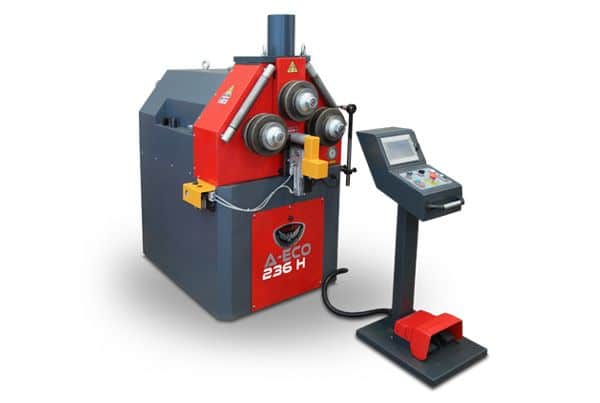
These small initial pinch rolls are designed for small part bending with low operation cost. R-ECO rolls feature robust cast iron frames, chain and gear driven drive systems and electric motors with a magnetic break which eliminates drifting. They also offer foot pedals with forward, reverse, and E-stop along with a safety wire and limit switch. A very economical, reliable, and efficient choice for your small parts needs.
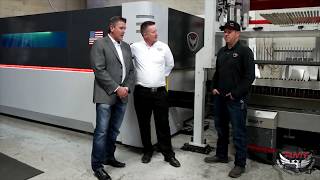
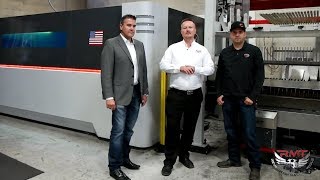
Fiber Nation a valued customer of ours gives us a testimonial on a Fiber Laser they bought from RMT years ago.
Presented by Kyle Jorgenson & Fiber Nation Executives (Anthony Evans & Dave Arbon)
Equipped with State-of-the-art technology, Fiber Lasers have become the leader in most CNC cutting applications. RMT Fiber Lasers feature unmatched cutting and travel speeds, all the while holding tolerances up to a thousandth of an inch.
For more information check out the RMT Fiber Lasers at https://rmtus.com/rmt-fiber-lasers.php
These small initial pinch rolls are designed for small part bending with low operation cost. R-ECO rolls feature robust cast iron frames, chain and gear driven drive systems and electric motors with a magnetic break which eliminates drifting. They also offer foot pedals with forward, reverse, and E-stop along with a safety wire and limit switch. A very economical, reliable, and efficient choice for your small parts needs.Learn more at https://rmtus.com/plate-rolls/
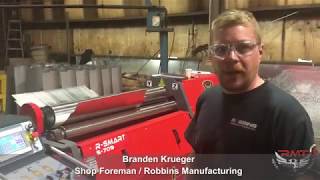
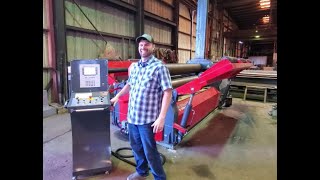
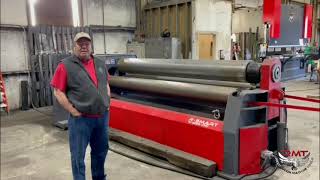
RMT R-SMART 10-866 Hydraulic 4 Rolls Plate Roll Machine - Testimonial by Absolute Metals
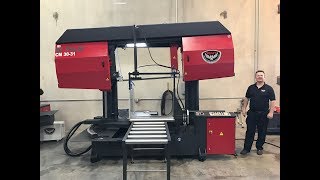
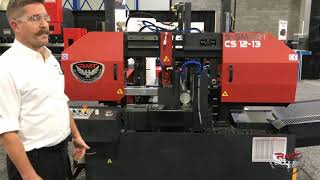
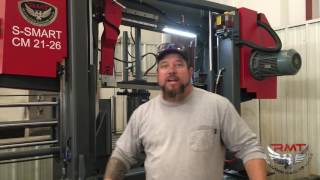
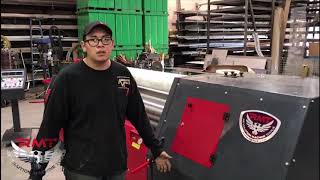
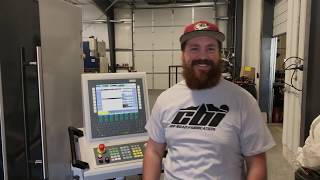
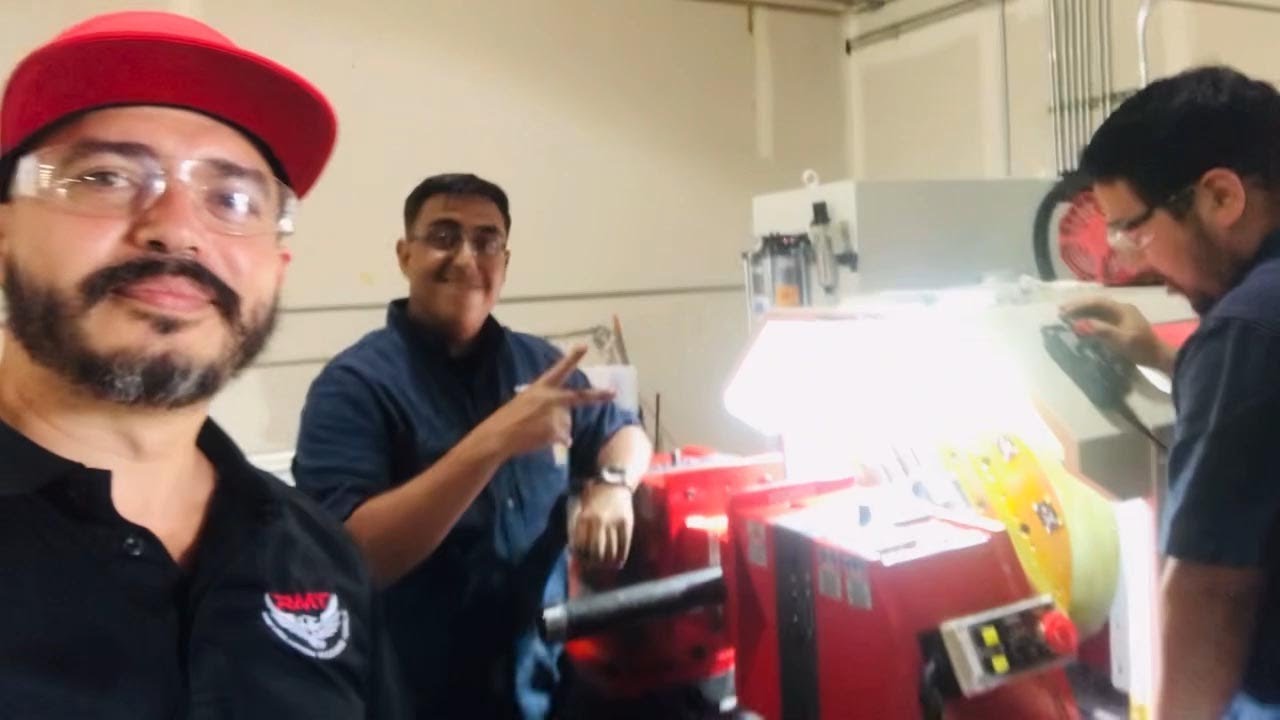
Scholzen a valued customer of RMT, gives a brief testimonial on the S-Fab Bandsaw they purchased to make their lives easier.Scholzen Products Co. HURRICANE, UT
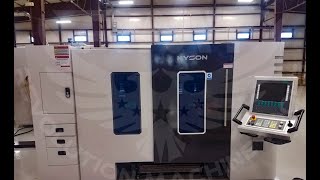
People love these KYSON Fiber Laser machines! Don't believe us? Just take a moment and watch this testimonial 🙂 Presented By: Jared (KYSON Operator)
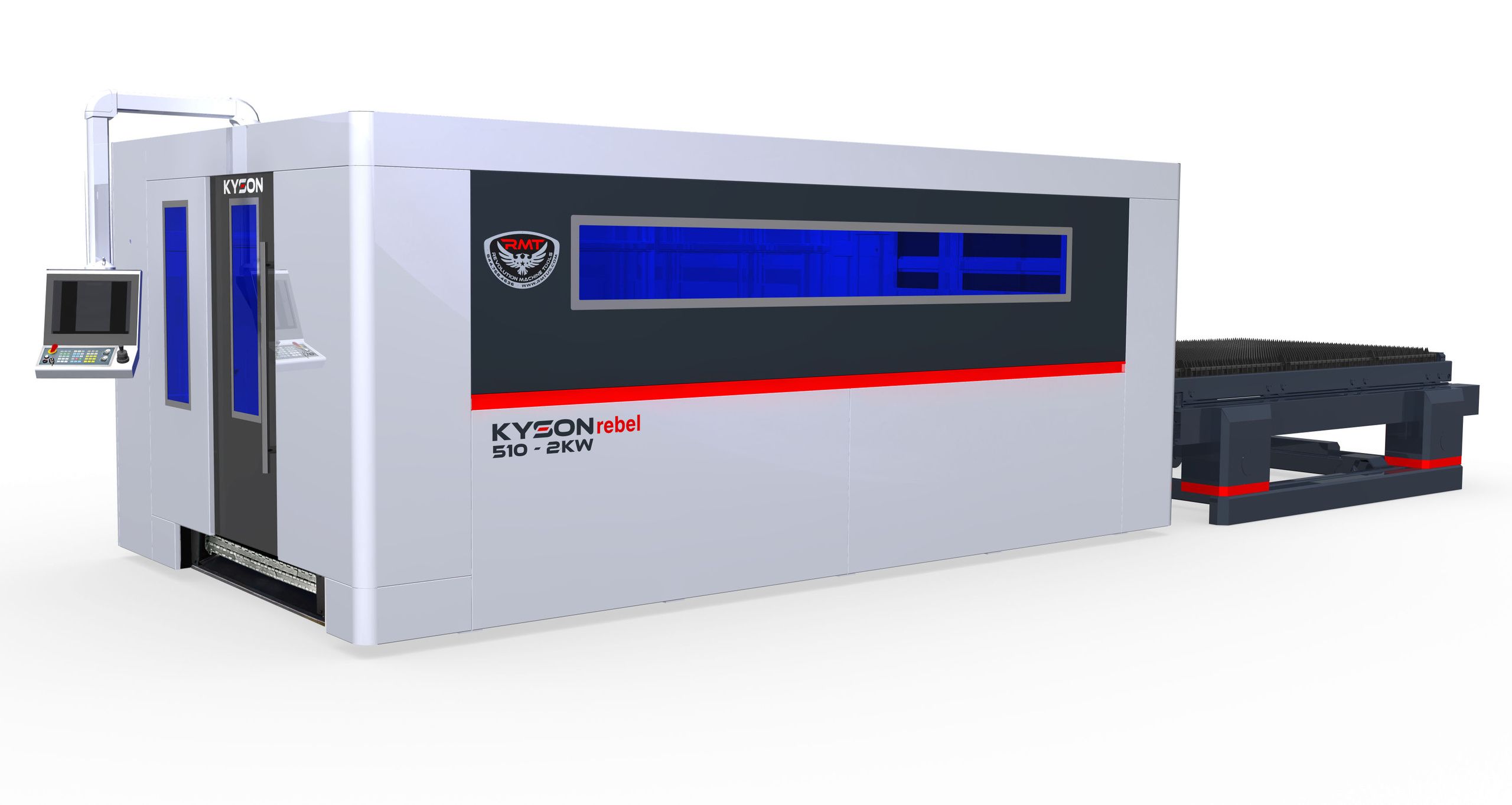
The RMT KYSON Series Fiber Laser is our latest design with a plethora of technological enhancements. The KYSON Fiber Laser’s speed, precision, reliability, and low operating cost is legendary and second to none.
Pro Fab and Welding of Pleasant Grove, UT became the latest recipient of one of our new metal cutting band saw models. Fully automatic and loaded with features this saw makes short work of large bundles, even allowing up to a 60-degree miter. Joe, the operator for Pro Fab and Welding has been working with saws for 25 years and told us that, "This saw kicks butt" and "runs better than any saw I've ever had." He also made several comments about really wishing he had a couple of them, to which we just smiled.
RMT S-Smart Bandsaw - Pro Fab & Welding Testimonial
SME Steel in South Jordan, Utah is a proud owner of an RMT Press Brake and Shear. RMT was able to train the SME workforce to operate the machinery, thus saving money and expanding the skills set of its workers. www.RMTUS.com
TeraFlex talks about their RMT B-Genius 10-150 Press Brake. This brake is designed and commissioned by Revolution Machine Tools and its dedicated Research and Development Team.www.RMTUS.com
"Support on it has been unreal" This is exactly what RMT like to hear! It's our goal and part of our mission to provide unparalleled support to each and every customer.
Plus Fiber Laser technology blows everybody's socks off. So check out our KYSON lineup at www.rmtus.com/rmt-fiber-lasers.php
Hammerton a valued customer of ours gives us a testimonial on a KYSON 510 3 kW Fiber Laser they bought from RMT.
Presented by Greg Paulson - Production Manager
Equipped with State-of-the-art technology, Fiber Lasers have become the leader in most CNC cutting applications. RMT Fiber Lasers feature unmatched cutting and travel speeds, all the while holding tolerances up to a thousandth of an inch.
For more information check out the RMT Fiber Lasers at https://rmtus.com/rmt-fiber-lasers.php
Here we have yet another great customer giving us great reviews! It also helps we give great prices for our machines. We're just great! But you can be too! 🙂
How do I know if I have the right TPI (tooth per inch) and tooth pitch for my cut?
Choosing the right TPI is key to clean, efficient cuts.
– Thin material: Use higher TPI to avoid snagging.
– Thick material: Use lower TPI for deeper bite.
– Cut type: Higher TPI for precision; lower TPI for fast, rough cuts.
Match blade pitch to your material and cutting speed to reduce wear. When unsure, check your machine manual—RMT lists recommended TPI ranges for each material and thickness.
How do I avoid flood coolant mess in my shop?
Flood coolant keeps tools cool but can get messy. Reduce it by using splash guards or enclosures, setting the right flow and nozzle aim, and keeping sumps, filters, hoses, and fittings clean and leak-free. Use proper coolant mix ratios, and consider mist or high-pressure systems when appropriate. Good containment and maintenance keep your shop cleaner without losing cooling performance.
How do I know if I need a manual, semi-automatic, automatic, or CNC bandsaw?
Choosing the right bandsaw depends on your material, production volume, and precision needs:
– Manual: Low-volume or occasional cuts; operator-controlled; budget-friendly and versatile.
– Semi-Auto: Operator starts the cut; machine controls feed; great for medium-volume work with less fatigue.
– Automatic: Fully automated cycle for high-volume, repetitive cuts; boosts efficiency and consistency.
– CNC: Programmed angles, batches, and complex cuts; ideal for high-precision, high-volume production.
Key factors:
Higher volume → more automation. Hard or large material may need auto feed/CNC. Manual is lowest cost; CNC offers top accuracy and efficiency.
How do I break in a bandsaw blade?
Breaking in a bandsaw blade prevents early wear and snapping.
1. Inspect: Check for defects, correct tension, and proper tracking.
2. Start slow: Run the saw empty at low speed to seat the blade.
3. Light cuts: Feed gently on the first few cuts—let the blade work at its pace.
4. Avoid stress: Keep cuts straight; don’t twist or pull the blade from a cut under load.
5. Recheck tracking: Stop after a few cuts and verify alignment.
6. Increase feed: Once settled, increase speed and pressure gradually.
7. Use coolant: Lubricate when needed to reduce heat and friction.
A new blade may cut rough at first, but it smooths out quickly.
How do I change a bandsaw blade?
1. Safety: Unplug the saw, wear gloves, and let the blade cool.
2. Release tension: Use the tension knob/lever.
3. Remove blade: Open wheel covers and slide the blade off, noting guide path.
4. Install new blade: Teeth down, loop onto wheels, seat in guides.
5. Set tension: Tighten to your machine’s specs.
6. Align tracking: Turn wheels by hand and center the blade.
7. Set guides: Position guides just behind the teeth with proper clearance.
8. Test run: Start at low speed and adjust if you hear rubbing or vibration.
Always check your manual for exact blade size and settings.
What is the benefit of using DropsA Lubrication?
DropsA Lubrication provides automatic, precise lubrication for CNC and industrial machines. Benefits include:
1. Consistent lubrication: Delivers exact amounts to prevent wear or damage.
2. Longer equipment life: Reduces friction and heat, extending bearings and gears.
3. Less maintenance: Cuts down manual greasing, freeing staff for other tasks.
4. Better performance: Machines run smoother, quieter, and more efficiently.
5. Cleaner, safer shop: Minimizes spills and reduces operator contact with grease.
6. Cost savings: Lowers downtime and lubricant waste.
How do I choose the right capacity / model for my needs?
To choose the right bandsaw:
Pick a model with throat depth and cutting height that cover your largest material sizes, a motor and speed range suited to the material type, and sufficient build strength for how often you’ll use it. Also ensure the saw fits your workspace and supports the blade sizes and features you need.
Are RMT Bandsaws highly customizable?
Yes, RMT bandsaws are highly customizable. You can choose from a variety of optional upgrades like hydraulic tensioning, lubrication systems (including DropsA), cooling systems, laser guides, and roller tables, and you can select the model and series that best match your automation and capacity needs.
What safety and usability features are built in?
RMT bandsaws include built‑in safety and usability features such as safety switches, guards, emergency stops, adjustable blade tension, variable speed control, coolant systems, blade brushes, and ergonomic controls. Higher‑end models add sensors for blade performance, automatic shutoff on abnormal conditions, and NC/CNC interfaces to make operation safer and easier.
How efficient are RMT Bandsaws in production environments?
RMT bandsaws are very efficient in production environments. With a range of automation from semi‑automatic to fully CNC‑controlled models, they deliver consistent, repeatable cuts with minimal operator input, helping boost throughput, reduce cycle times, and lower downtime — making them well‑suited for high‑volume metal cutting.